Friday, March 4, 2016

Fiscal Policy

. Changes in the expenditures or tax revenues in the federal government
-2 tools of fiscal policy
Taxes and Spending

Deficits, Surplus, and Debts 

. Balanced Budget
. Revenues = Expenditures
Deficit Revenue<Expenditures
Budget Surplus Revenues.Expenditures
.Government Debt
Sum of deficits- sum of expenditures
Government must burrow money when they are in a budget deficit
. Government burrows from
-individuals
-corporations
-financial institutes
-other governments or foreign leaders

Fiscal Policy Options

.Discretionary fiscal policy (action)
Non-Discretionary fiscal policy (no action)
Expansionary Fiscal Policy
. combat recession
. increase government spending
.decrease taxes


Contractionary Fiscal Policy
.combat inflation
.decrease government spending
.increase taxes

AP Macroeconomics Consumption and Savings


Disposable Income ( Di)
.income after taxes or net income
.DI= gross income - taxes

2 choices
.with disposable income, households can either
-consume
-save

Consumption
.household spending
. the ability to consume is constrained by
-the amount of disposable income
- the propensity to save
. Do households consume if Di = 0?
-autonomous consumption
-dissaving

Saving
.household net saving
.the ability to save is constrained by
-the amount of disposable income
- the propensity to consume
.Do households save if Di=0?
-NO

APC and APS 

APC- average propensity to consume
APS- average propensity to save
APS+APC=1

Marginal Propensity to consume

. the fraction of any change in disposable income that is consumed
MPC= C/DI


Marginal Propensity to Save

. the fraction of any change in disposable income that is saved
MPS= S/DI

MPC+MPS=1
.only two options either to consume or to save


The spending multiplier effect

. An initial change in spending causes a larger change in aggregate spending
Multiplier= Change in AD/ Change in spending

Calculating the spending multiplier
Multiplier = 1/1-MPC or 1/MPS
.Multipliers are positive when there is an increase in spending and negative when there is a decrease

Calculating the Tax multiplier
When the government taxed, the multiplier work in reverse because money is leaving the circular flow
Tax multiplier = -MPC/1-MPC or -MPC/MPS

Notes on Investments and Investment Demand


Investments- Money spent on expenditures on-
-new plats (factories)
-capital equipment (machinery)
-New homes
-inventories (goods sold by producers)
Expected Rates of Return
How do businesses make these investment decisions?
-cost/benefit analysis
.How do business determine the benefits?
-expected rate of return
.How does business count the cost
-interest costs
.How does business determine the amount of investment they undertake?
-compare expected rate of return to interest cost
.if expected return> interest cost then invest and vice versa.

Real(r%) v. Nominal (i%)
. Nominal is the observational rate of interest. Real Real inflation is only known as an ex post facto thing.
Compute real interest rate; i%-m%
r% determines cost of investment decision

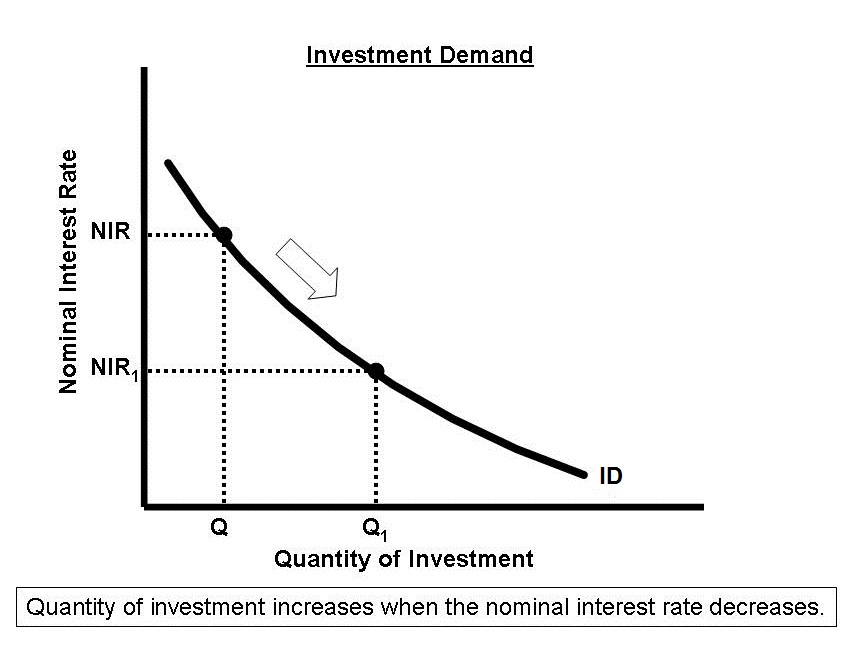
Investment Demand curve (ID)
Shape: Downward sloping
Why - When interest rates are higher fewer investments are profitable, when interest rates are low more investments are profitable.

Shifts in interest Demand (ID)
-Cost of production
lower costs causes  shift to the right
Lower business taxes cause a shift to the right
New Technological changes cause a shift to the right
Low capital causes a shift to the right
Positive expectations cause a shift tot he right
and the opposite of all these cause a shift to the left.

Notes on SRAS


Nominal wages-it is the amount of money received by a worker per unit of time.

Real wages-it is the amount of goods and services a worker can purchase with their nominal wages. The purchasing power of your nominal wage

Sticky Wages-Nominal wage level is set according to an initial price level and it does not vary due to labor contracts or other restrictions.

Keynesian Range- Recession, Price is fixed, wages are fixed, the employment level is flexible, and output depends upon changes int he employment level.

Intermediate Range- Price is flexible, wages are fixed, employment level is flexible, and output depends upon changes in price level and employment level.

Classical Range- Inflation, Price is flexible, wages are flexible, employment level is fixed, output is independent in the changes of the price level.

Aggregate Demand Curve


AD= C+I+G+Xn

Why is Ad downward sloping?


1.Real interest rate effect
.higher price levels reduce the purchasing power of money
.this decreases the quantity of expenditures
.Lower price levels increase purchasing power, and increase expenditures

2.Interest rate effect
.When price level increases lenders need to change higher interest rates to get  a REAL return on their loans
.Higher interest rates discourage consumer spending and business investment

3.Foreign Trade effect
.When the U.S. price level rises, foreign buyers purchase fewer U.S. goods and Americans buy more foreign goods.
.Exports fall and imports rise causing real GDP demanded to fall. (Xn decreases)

Shifts in Aggregate Demand

Shift in AD 

.Two parts
-a change in C, I,G,Xn
-a multiplier effect that produces a greater change than the actual change
An increase in Ad leads to a shift to the right
A Decrease in Ad leads to a shift to the left.

Determinants of AD

Consumption-consumer wealth-more wealth=more spending
-consumer expectation Positive expectations=more spending
Household indebtedness less debt=more spending
- Taxes less=more spending
And vice versa

Gross Product domestic investment
-the real interest rate
. lower real interest rate = more investment
-expected returns
.Higher expected returns=more investment
.expected returns are influences by
.expectations of future
-technology
-Degree of excess capacity ( existing stock of capital)
-business taxes

Government spending
More Ad shifts to right
Less Ad shifts to Left

Net Xports
.Exchange Rates ( international value of $)
Strong dollar equals=more imp and  fewer exports Ad shift to the left
Relative income
-More income= More exports AD shift to the right


NOTE: For all these AD shifts I am only giving one of the possibilities for each, the AD shift in the opposite direction means an opposite change in circumstances.